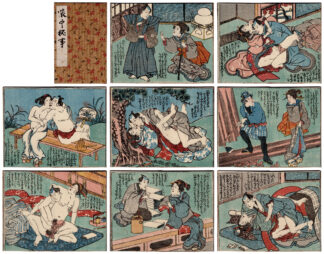
During Japan’s Edo period (1603–1867), shunga erotic prints occupied a shifting legal gray area, thriving openly for decades before facing censorship.
While the Tokugawa shogunate periodically issued edicts banning sexually explicit books and prints, enforcement was uneven. Publishers, artists, and collectors found clever ways to keep this vibrant art form alive across centuries of social change.
Early tolerance and the Kyoho Reforms
Throughout the 17th century, shunga circulated widely in major cities like Edo (modern Tokyo), Kyoto, and Osaka. Publishers sold illustrated erotic albums openly alongside theater programs, travel guides, and poetry collections. Because these prints often served as talismans for fertility and marital harmony, authorities rarely intervened.
The first major crackdown arrived in 1722 with the Kyoho Reforms. Aiming to curb luxury and enforce Confucian public morality, the shogunate prohibited the publication of unlicensed erotic works. Yet rather than disappearing, shunga adapted. Artists simply omitted their signatures and publishers removed their colophons, allowing luxury prints to circulate discreetly through private lending libraries (kashihon’ya).
The Tenpo Reforms and underground mastery
By the late 18th and early 19th centuries, leading ukiyo-e masters—including Kitagawa Utamaro, Katsushika Hokusai, and Utagawa Kunisada—created some of the finest woodblock prints in Japanese history. If you explore a brief history of shunga on Shunga.shop, you will see that the genre reached its technical peak during this exact era of nominal prohibition.
A harsher wave of suppression struck during the Tenpo Reforms of 1841–1843. Government censors fined publishers, destroyed carved woodblocks, and briefly imprisoned prominent artists. Even then, demand among samurai, merchants, and townspeople remained unstoppable. Underground workshops continued producing multi-color prints with extraordinary metallic pigments and blind embossing (karazuri), treating the bans as a minor obstacle rather than an end to production.
Why authorities rarely wiped out shunga
Unlike Western societies that condemned erotic art on religious grounds, Edo-period officials viewed shunga primarily as a matter of public order and sumptuary control. As long as prints avoided political satire or depictions of high-ranking samurai officials, local magistrates often looked the other way.
Moreover, shunga was deeply woven into everyday customs. Families tucked erotic woodblock prints into bridal trousseaus, while travelers carried small shunga albums as good-luck charms. This cultural acceptance—combined with the playful humor behind why genitalia are so large in shunga prints—ensured that collectors preserved thousands of examples in remarkable condition.
From Meiji censorship to modern appreciation
Strict, systematic censorship only took hold after the Meiji Restoration of 1868, when Japan modernized its legal code along Western lines and banned explicit imagery under obscenity laws. Ironically, while domestic restrictions tightened, European Impressionists and collectors eagerly acquired Edo-period shunga abroad. Today, these surviving woodblock prints are celebrated worldwide as masterpieces of graphic design, technical craftsmanship, and human warmth.